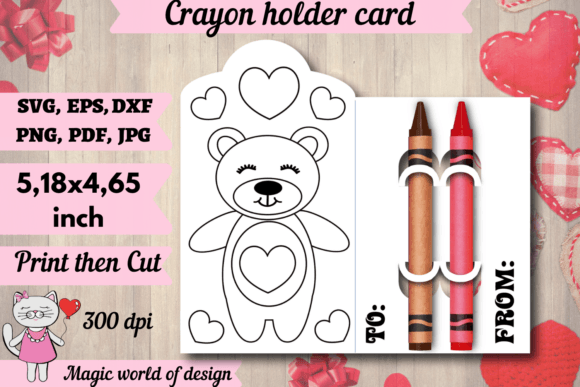
Valentine’s Bear Coloring Card: A Designer’s Review
As an embroidery designer who has spent years digitizing motifs and testing them on everything from stiff denim to delicate baby knits, I approach every new machine embroidery design with a critical eye. It is not just about whether the image looks cute on a screen; it is about how those lines translate into thread, how the fabric behaves under the needle, and ultimately, whether the finished product holds up to real-world use. Recently, I evaluated the Valentine s Day Bear Coloring Card Holde, a digital asset that sits at the interesting intersection of paper crafts and textile art. While the product description highlights its utility as a coloring card for cutting machines like Cricut or Silhouette, my focus was strictly on its potential within the realm of embroidery and handmade textiles.
First Impressions: Mood and Visual Personality
The first thing that strikes you about this design is its inherent charm. The bear motif is classic, evoking a sense of nostalgia and warmth that is perfect for Valentine’s Day. The layout, measuring approximately 5.18 by 4.65 inches, offers a substantial canvas for detail without being overwhelmingly large. For an embroidery project, this size is versatile. It is large enough to serve as a focal point on a tote bag or a pillow cover, yet compact enough to fit comfortably on a child’s sweatshirt or a decorative patch.
The visual personality of the Valentine s Day Bear Coloring Card Holde leans towards the playful and sweet. This is crucial for designers because the mood dictates the market. A design this approachable naturally belongs to categories like baby embroidery, holiday gifts, and boutique branding for family-oriented small shops. However, the "coloring card" aspect suggests clean, defined outlines. In embroidery terms, this often translates well to satin stitch borders or precise running stitches, provided the digitization respects the original line work. If the lines are too thin or intricate, they may get lost in the texture of the fabric, so understanding the source graphic is key.
Real-World Application: From Screen to Stitch
To truly understand the value of this graphics asset, I imagined applying it to several common crafts scenarios. Let’s consider a custom embroidered tote bag. Tote bags are typically made from canvas or heavy cotton, which have a distinct weave. A design like this bear, with its likely bold shapes, would stand out beautifully against such a textured background. The key here is stitch density. If the design is converted or used as an applique design, the fabric choice becomes part of the aesthetic. Using a contrasting fabric for the bear’s body could add depth, while the outlines could be secured with a neat satin stitch.
Another practical application is sweatshirt embroidery. Here, the challenge shifts to handling stretchy, piled fabric. The 5.18 x 4.65-inch dimensions are ideal for the left chest or a larger back print. However, one must be cautious with dense fill stitches on fleece or terry cloth, as they can cause puckering. If this design is intended for such garments, using a proper stabilizer is non-negotiable. A cut-away stabilizer would provide the necessary support to keep the bear’s shape crisp after multiple washes. For a personalized gift, adding a name beneath the bear in a complementary font could elevate the perceived value, turning a simple motif into a cherished keepsake.
For Etsy sellers and small shop product creators, this design offers flexibility. It can be scaled down for embroidered patch production, where high-density stitching and merrowed edges create a professional finish. Patches are a trending item, and a Valentine’s theme sells well year-round, not just in February, due to its association with love and affection. Alternatively, it could be used on kitchen towels or aprons, adding a touch of whimsy to home decor. In each case, the handmade product appeal is strengthened by the recognizable, friendly nature of the bear character.
Navigating Technical Challenges
While the design is appealing, there are areas where caution is required. The description notes it is a coloring card, which implies internal details meant to be filled in by hand. In embroidery, translating these internal details requires careful planning. Tiny lettering or intricate internal patterns may not stitch out cleanly if the thread colors do not have sufficient contrast or if the stitch count is too low to define the shape. I always advise testing the design on scrap fabric first, preferably in both light and dark colors, to see how the threads interact with the background.
Curved surfaces, such as caps or hats, present another challenge. The 5.18-inch width might be too wide for a standard cap front panel unless the design is significantly scaled down. Scaling down reduces stitch density, which can lead to gaps in coverage or unstable stitching. If you plan to use this on a cap, consider simplifying the design or using an applique technique to reduce the number of stitches while maintaining the visual impact. Additionally, on thin or stretchy fabrics, the weight of the embroidery can distort the garment. Using a hoop size that adequately supports the fabric without stretching it excessively is vital for maintaining the integrity of the embroidery project.
Enhancing Brand Consistency and Customer Trust
For commercial embroidery professionals and creative entrepreneurs, consistency is key. Using a design like the Valentine s Day Bear Coloring Card Holde can help build a cohesive brand identity if it aligns with your shop’s aesthetic. Whether you specialize in baby embroidery or holiday embroidery, the quality of the stitch-out reflects directly on your brand. A clean, well-executed bear motif signals professionalism and attention to detail, which builds customer trust.
Moreover, the versatility of this design allows for diverse marketing strategies. You can create printable mockup images showing the bear on various products, helping customers visualize the final result. This is particularly effective for digital embroidery file sellers who want to demonstrate the potential of their assets. By showcasing the design on a cozy blanket, a stylish tote, or a cute onesie, you provide tangible inspiration that drives engagement and sales.
Practical Notes for the Embroidery Designer
Before committing to a full production run or listing this as a design assets product, there are several steps I recommend. First, verify the licensing terms. Since the original product is described as a coloring card for cutting machines, ensure that using it for embroidery and selling the finished items is permitted. Intellectual property rights vary, and clarity here protects your craft business.
Second, test the design in black and white. This helps identify any issues with contrast and detail definition that might be masked by color. Third, experiment with different thread colors to find combinations that enhance the bear’s features. Soft pastels might work well for baby items, while vibrant reds and pinks could emphasize the Valentine’s theme. Finally, consider the fabric texture. A smooth cotton will show off fine details better than a rough linen, so choose your material wisely based on the complexity of the stitch pattern.
In conclusion, the Valentine s Day Bear Coloring Card Holde offers a delightful foundation for various embroidery projects. With careful attention to technical details like stabilizer choice, stitch density, and fabric compatibility, it can be transformed into a high-quality custom apparel piece or a charming home decor item. For designers willing to put in the preparatory work, this design holds significant potential for creating memorable, sellable products.